Transformer
Transformer
A transformer is a passive electrical device that transfers electrical energy from one electrical circuit to another, or multiple circuits. A varying current in any one coil of the transformer produces a varying magnetic flux in the transformer's core, which induces a varying electromotive force across any other coils wound around the same core. Electrical energy can be transferred between separate coils without a metallic (conductive) connection between the two circuits. Faradays's law discovered in 1831, describes the induced voltage effect in any coil due to a changing magnetic flux encircled by the coil.
Transformers are most commonly used for increasing low AC voltages at high current (a step-up transformer) or decreasing high AC voltages at low current (a step-down transformer) in electric power applications, and for coupling the stages of signal processing circuits. Transformers can also be used for isolation, where the voltage in equals the voltage out, with separate coils not electrically bonded to one another.
Since the invention of the first constant potential transformer in 1885, transformers have become essential for the transmission,distribution and utilization of alternating current electric power. A wide range of transformer designs is encountered in electronic and electric power applications. Transformers range in size from RF transformers less than a cubic centimeter in volume, to units weighing hundreds of tons used to interconnect the power gird.

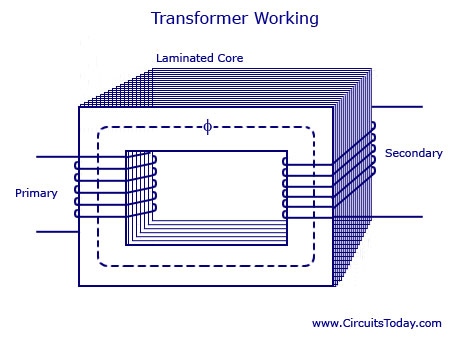
As shown above the electrical transformer has primary and secondary windings. The core laminations are joined in the form of strips in between the strips you can see that there are some narrow gaps right through the cross-section of the core. These staggered joints are said to be ‘imbricated’. Both the coils have high mutual inductance. A mutual electro-motive force is induced in the transformer from the alternating flux that is set up in the laminated core, due to the coil that is connected to a source of alternating voltage. Most of the alternating flux developed by this coil is linked with the other coil and thus produces the mutual induced electro-motive force. The so produced electro-motive force can be explained with the help of Faraday’s laws of Electromagnetic Induction as e=M*dI/dt
If the second coil circuit is closed, a current flows in it and thus electrical energy is transferred magnetically from the first to the second coil.
The alternating current supply is given to the first coil and hence it can be called as the primary winding. The energy is drawn out from the second coil and thus can be called as the secondary winding.
In short, a transformer carries the operations shown below:
- Transfer of electric power from one circuit to another.
- Transfer of electric power without any change in frequency.
- Transfer with the principle of electromagnetic induction.
- The two electrical circuits are linked by mutual induction.
Comments
Post a Comment